THE COWBOY AS IDEAL, THE ALIEN AS REAL
Studio visit with Laura Lambuth
Hadi Nasiri
I keep thinking about waiting, not as downtime, not as a pause, but as a condition that is unevenly distributed. In the United States right now, waiting is not neutral. It is structured. Some bodies are allowed to wait without consequence; others are monitored, expedited, delayed, or removed. Waiting becomes a quiet form of governance. Airports make this legible: who moves freely, who is inspected, who belongs everywhere and nowhere at once.
A similar waiting in an image pulled me into Laura Lambuth’s studio at Pratt open studio in fall 2025. An oil-painted airport window on an unframed canvas: a cowboy paused between departure and arrival. Waiting here looks calm, even dignified. But that calm already assumes safety. It assumes that waiting will end.
It’s January 2026. I return to Laura’s studio, not only to revisit that image but to examine what that waiting permits. Her work gathers three figures currently circulating through American anxiety: the cowboy, the alien, and the martyr. What looks like genre painting is not innocent. It is myth under pressure.
The studio is fluorescent and communal. Dishes clatter from the kitchen next door. She apologizes for the noise. I’m still standing when we begin, stepping forward and back, trying to find angles that don’t flatten the room. She keeps adjusting things while I move.
“If you want to sit, you can turn around,” she says. Then, almost immediately: “Yeah, but not for now.”


The work begins before the interview. The interview begins while I’m still looking.
I return to the airport painting, not as atmosphere, but as system. Airports are sorting machines. They decide who waits calmly and who waits under scrutiny. In her painting, the cowboy stands intact. Unsearched. Unhurried.
When I ask what is happening in the painting, she speaks about homesickness. Transition. Anxiety.
“I’m very, very anxious… especially whenever, ironically, whatever comes with flying.”
She tells me she doesn’t understand how planes work. That not-knowing unsettles her. The cowboy becomes the opposite of that uncertainty.
“A character that I’ve been creating is always very passive… things are just happening and I am going with the flow.”
The calm is aspirational. He is who she wishes she could be inside systems she doesn’t trust.
But calm, in the United States, is not evenly distributed. A white cowboy waiting at a window reads as poetic. Another body in that same posture might be searched, flagged, delayed. When she says he reflects strength, I hear something else: strength that assumes the system will process him gently.
The painting does not name that privilege, but it quietly depends on it.

From the kitchen, something crashes again. She winces. “This is why it kind of sucks being right next to the kitchen. Cause I hear everything.” The room refuses silence. The West never arrives cleanly; it arrives interrupted.
She was born in Houston and raised in Colorado, but the West in her paintings comes through museums and cinema.
“That’s kind of the West that I know is through their art.”
The canvases are slow, tonal, carefully composed. Built from layered references and memory. Nothing is spontaneous. The myth is labored.
“Heavily referenced… from vague memories.”
This is not the West lived. It is the West learned.
When I ask whose land this is, she pauses.
“It’s tough. It’s incredibly important but sometimes hindering. I don’t want to rewrite history.”
Instead, she speaks about infatuation, with how the West has been depicted in other paintings.
Infatuation is aesthetic. It is safer than confrontation.
When we choose depiction over rupture, beauty over fracture, we are not neutral. We are curating what gets softened. The desert in her work is longing. But longing can become a veil.
I finally sit, not because tension resolves, but because I’ve run out of positions. The photos are taken, yet I’m still scanning the walls as if documentation hasn’t stopped. I ask whether she wants to lead the visit. She hesitates, not from uncertainty, but from preference.
So I turn to the sketchbook.

“I’ve always been a very sketchbook-oriented person. I lived in it. I’ve kept every sketchbook I’ve made since I was a toddler.”
She places one on the table. It feels less like a sketchbook and more like a dossier.
“I want my sketchbooks to be considered in the same way that my paintings might be. They feel like blueprints.”

As I flip through the pages, I don’t see preparatory drawings so much as field notes, an attempt to record a culture while inhabiting it. Roswell headlines sit beside presidents holding UFO newspapers;


fragments of dialogue hover in a voice not entirely her own. Red circles surround televised faces, margins thick with questions. Conspiracy headlines rest beside Catholic iconography without hierarchy; aliens and saints share visual space; government distrust and devotional imagery occupy the same spread. It is not random collage but an archive of American belief under stress.
Then: Saint Sebastian.
He appears again and again in her references — bound, pierced, luminous. An exposed male body punctured by arrows, yet rendered serene. The martyr does not resist. He endures. His suffering is aestheticized, sanctified, made beautiful through repetition. In the Western canon, pain does not merely wound; it authorizes. The body that absorbs violence becomes holy.
Unlike the cowboy, who performs autonomy, the martyr performs endurance. Unlike the alien, who embodies epistemological anxiety, the martyr stabilizes meaning through sacrifice. He does not move. He does not question. He remains.
In her sketchbook, Sebastian sits beside UFO headlines and televised conspiracies without hierarchy. That juxtaposition is not accidental. Both the alien and the martyr revolve around belief without proof. Both circulate through testimony, image, repetition. But where the alien destabilizes, the martyr reassures. He is a known image. A recurring figure. She once described the pleasure of recognizing him in paintings — the comfort of seeing the arrows and knowing immediately who he is. Recognition becomes security.
Canon works this way. It trains the eye. It makes certain bodies instantly legible as meaningful.
The martyr’s body is also overwhelmingly male. Bound to a tree, displayed for spectators, pierced yet composed. Masculinity here is not agency but endurance. Suffering without collapse. Pain without spectacle of weakness. Even vulnerability is coded within a framework of nobility. The arrows do not feminize him; they elevate him.
This matters.

Because in American myth, suffering is rarely neutral. It becomes narrative. It becomes legitimacy. It becomes proof of moral depth. The wounded soldier. The stoic rancher. The man who absorbs impact and remains upright. The cowboy and the martyr are not far apart. One rides into danger; the other remains pinned within it. Both are stabilized through repetition.
In her studio, the martyr does not function as theological declaration. He functions as aesthetic anchor. A figure that returns. A body that has survived centuries of depiction. If the cowboy is aspirational, the martyr is historical weight. If the alien is destabilizing doubt, the martyr is codified endurance.
And I begin to see how the three figures interlock.
The cowboy imagines control.
The alien exposes uncertainty.
The martyr dignifies suffering.
Together they form a psychological structure — ideal, anxiety, endurance. But they also form a cultural one. Agency, paranoia, sacrifice. Each of them circulates beyond her studio walls. Each carry sedimented histories that exceed her intention.
The martyr, like the cowboy, is not neutral simply because he is familiar. Familiarity is how canon protects itself. The body pierced by arrows becomes beautiful through repetition. The image survives because we know how to read it. And once an image is canonized, it resists displacement.
To archive him again, to redraw him, to place him beside aliens and cowboys, is not innocent. It is to participate in that canon’s continuation, even if the gesture is reflective rather than devotional.
This is not casual collection. It is classification—a mapping of belief systems from within.
The pages are dense, not because they are chaotic, but because they feel total, like opening someone’s hard drive or placing a culture under clinical light.
When I ask why the “cowboy” persists, she doesn’t sanctify him.
“It’s like a language. More like a tool. Kind of like props… a drop.”
If he is a prop, he is detachable. If detachable, history becomes aesthetic resource. The Marlboro man surfaces. Advertisement. Pop culture.
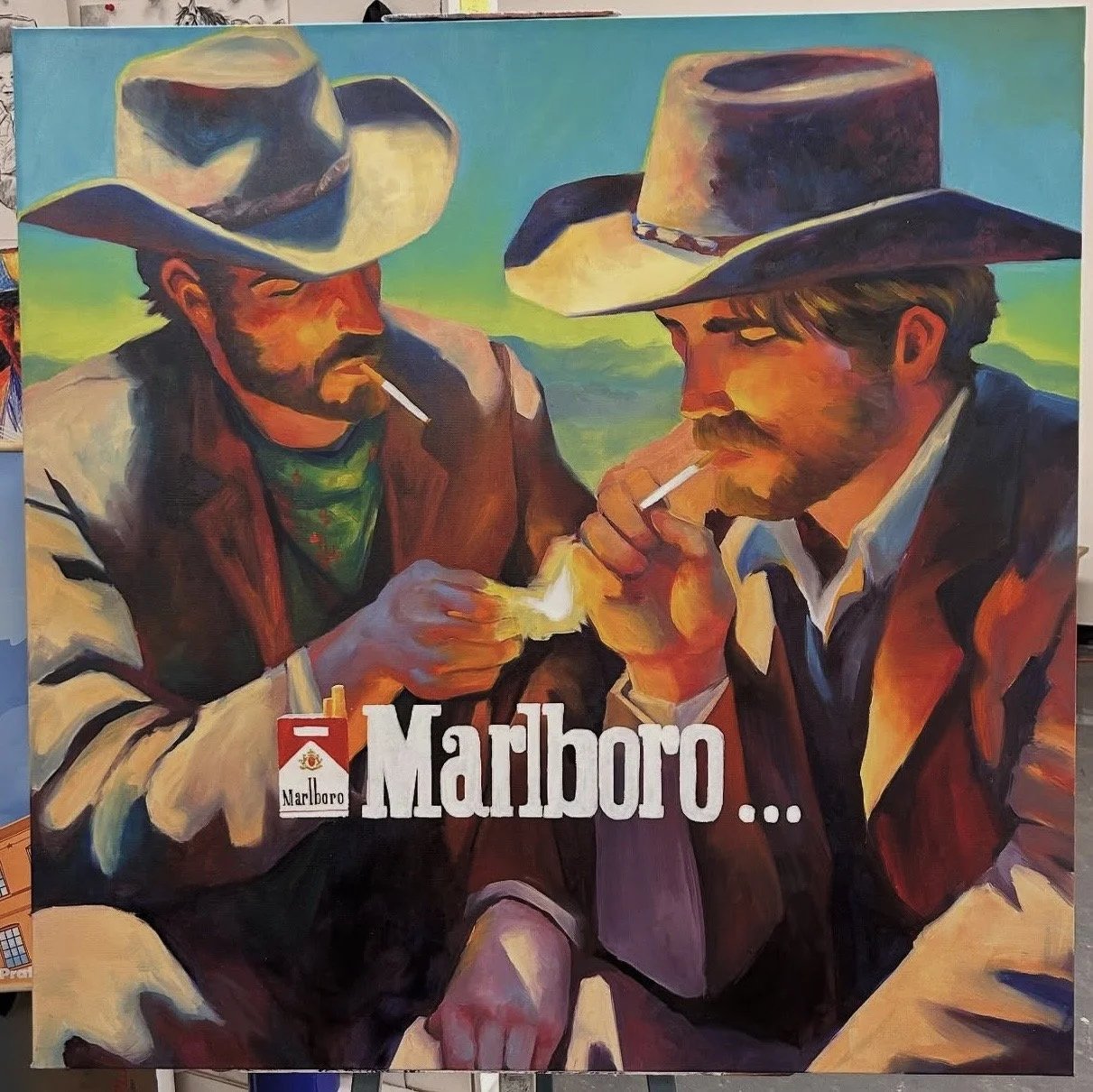
“If I buy a nicer boot or a hat, I’m in.”
The West survives through purchase.
And here the risk sharpens: the cowboy is not only symbol. He is brand. When she paints him, even with nuance, she re-circulates the silhouette. Is repetition critique? Or reinforcement?
That stabilization was already on my mind before I entered the studio.
The question did not begin with Laura.
It began in the presidential debates, in the repetition of male composure presented as steadiness, in the recurring hesitation around whether the United States is “ready” for a woman president, while Mexico has already crossed that threshold. Authority in America still often looks male. Myth does not live only in paintings; it circulates through podiums and ballots.
So, when I step into Laura’s studio and see cowboys, knights, gladiators—overwhelmingly male figures, the question is already charged.
She tells me she is “surprised by how often gender is brought up” because she “personally doesn’t consider it an integral part” of her work. When she paints a male-presenting cowboy, she is not thinking about her own gender. She is thinking about “what our culture views as the quintessential cowboy character” for her, the Marlboro man. She is thinking about “the aesthetic and attitude that is exuded by him,” not the historical context for why the cowboy is viewed as male.
Critiques that reduce the conversation to why she is not painting herself as a woman have felt, she says, like “attacks to [her] identity.”

Most of her role models, she explains, “happen to be male.” That does not mean women are absent from her life or influence “they’re very present”—but what they represent is not necessarily embodied through female figures in the paintings. The traits she seeks strength, composure, adaptability, she does not see as inherently masculine. “Society and tradition may state that certain traits belong to certain genders,” she says, “but I don’t see it that way.”
Women do not appear as central protagonists because she does not want the work to become about gender. “My truth has nothing to do with my gender identity,” she tells me. The cowboy, for her, conveys the internal conflicts she is mapping more clearly than a cowgirl would.
She insists the choice began as neutral. “It’s the default simply by chance.” Pop culture has decided the cowboy is male; therefore, he appears male in her paintings. The image feels gender neutral to her. The masculine look is simply part of the iconic aesthetic.
Here is the anthropological tension.
Historically, the cowboy is not neutral. He is one of the most gendered American archetypes we have a vessel that has carried coded masculinity across decades of film, advertising, and political imagination. Even if approached as aesthetic shorthand, he does not arrive empty.

Laura is not staging parody. She is not dismantling the archetype. It would be easier, she admits, if she were using these figures purely for critique. But they “mean so much more” to her than that. They are psychological tools, the cowboy as ideal, the alien as real, the saint as comfort.
Gender, she says, “hasn’t worked its way into that narrative.”
But outside the studio, myth continues to function structurally. Public discourse still codes steadiness and authority in male tones. When the cowboy appears calm, autonomous, centered, he does so in a country where masculinity still circulates as default authority.
This does not make her responsible for that inheritance. But it does mean the work participates in it.
If the cowboy feels gender neutral to her, that feeling itself is anthropologically significant. It suggests how thoroughly myth can naturalize a coded image, how the masculine body can read as human before it reads as male. Yet when she speaks about him, it is not history she describes—it is longing.
“I idolize him so much. I wasn’t raised like this even remotely. I’m the one wearing the costume.”
The strength she admires—stoicism, adaptability, composure has long been culturally coded masculine. Inside her studio, it reads as desire. Outside, in this political climate, it carries different weight. Aestheticizing stoic masculinity cannot remain entirely neutral. The cowboy does not stay inside oil paint. He migrates.
“They’re trapped in my composition,” she says. “I’m not exactly creating them with freedom in mind.”
America markets freedom as mobility. Most people experience it as structure. The myth of independence persists because real independence feels constrained. If freedom is already theatrical, painting it may not dismantle the stage—but refine it.

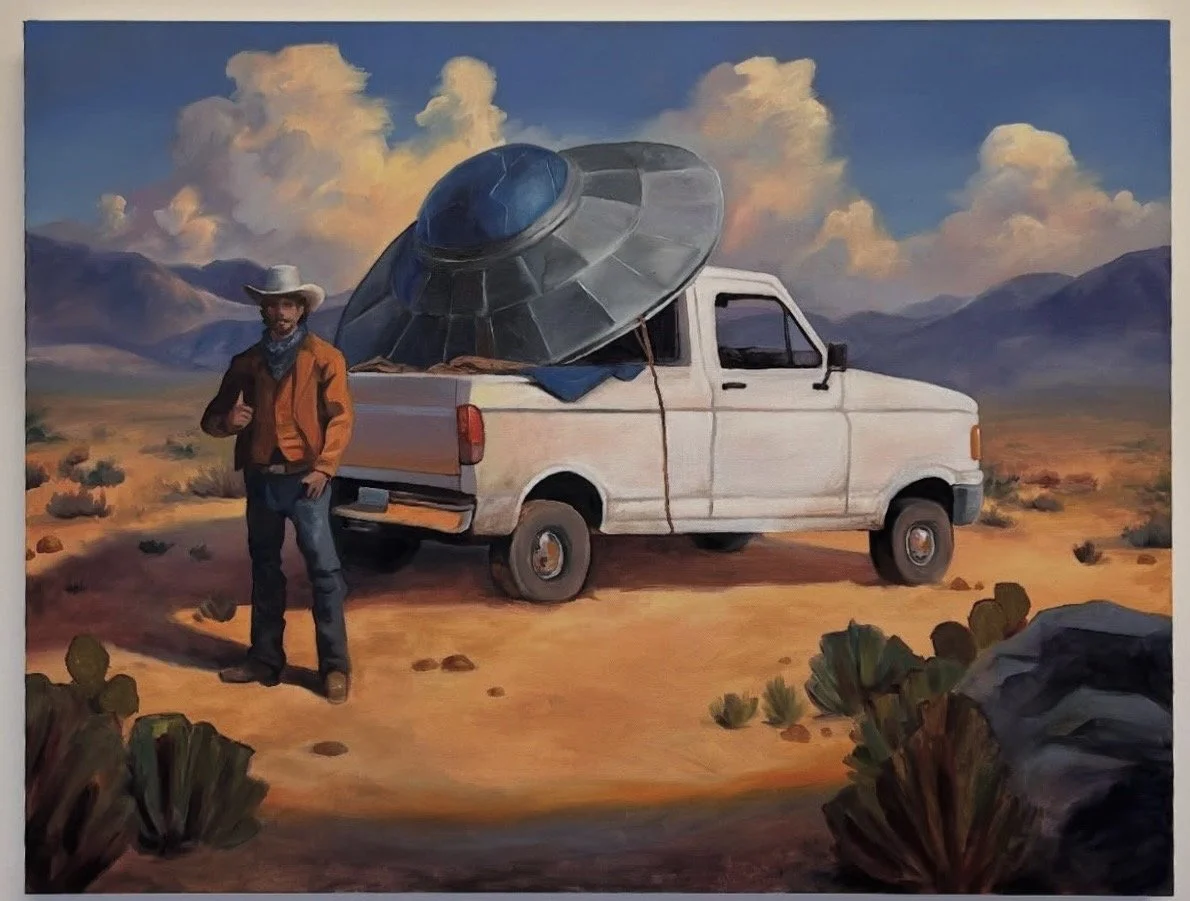
Then the alien enters.
At first mockery. Then paranoia. Nightmares.
“The alien… is a more accurate self-portrait to me than the Cowboys.”
She distrusts systems she cannot see. She doesn’t understand planes. She knows images are fabricated.
“Every image you’re looking at is fabricated.”

The alien becomes epistemology, the fear of invisible structures. The cowboy is certainty. The alien is doubt. Saint Sebastian becomes comfort through recognition.
“I really don’t like change,” she says. “I want these things to stick around.”
The studio is not dismantling myth. It is preserving it. Consciously. Carefully.
If she stops painting the cowboy, the ideal dissolves. If she continues, the silhouette persists.
The dishes clatter again.
The cowboy remains the ideal.
The alien remains the doubt.
The martyr remains the wound made luminous.
These figures do not argue. They endure. They circulate. They survive.
If myth stabilizes through familiarity, then repetition is not innocent. The silhouette does not dissolve simply because it is painted with nuance. It persists because we know how to read it. Because it feels natural. Because it feels neutral.
And neutrality is the most durable costume of all.
When I leave the studio, nothing has collapsed. The canon is intact. The silhouettes still stand. The arrows still pierce without destabilizing the body. The question is not whether these myths will disappear.
The question is who they continue to authorize—and who remains outside the frame while they endure.
Laura Lambuth
@humblethemumbliest