Intimacy as Structure: Lovers
Studio visit with Veronika Desova
Hadi Nasiri
There was talk of ceasefire, of pause, of negotiation. It faltered. Something was proposed, partially agreed, then failed to hold. The structure does not return. It lingers in suspension.
Forty-two days have passed since the first strike on Iran. A state-imposed internet shutdown has been enforced by the Islamic regime. Arrested protesters are being executed. The numbers continue, but time no longer behaves. Events accumulate without forming a sequence, not an explosion but a loss of coherence, a system still running but no longer holding. I try to think through it, but thought itself refuses structure. For someone who has spent years working through the idea of structure, this feels less like crisis than collapse.
I try to move away from it. On the Garden State Parkway, I tell myself to focus on the studio visit, on something smaller, more contained. But memory does not follow instruction. Hormuz returns, not as image but as condition. Heat. Dust. Distance. I miss my exit. By the time I notice, I am already elsewhere. It feels less like a mistake than confirmation. Even navigation has begun to fail. I am not looking for metaphor. I am looking for a structure that can hold contradiction without resolving it.
I reroute, park in Jersey City, and take the PATH. A different system. More legible. More reliable. I move quickly once I arrive. Veronika messages to confirm the meeting. I answer: “I’ll be there in 15 min.” Short. Functional. Enough.
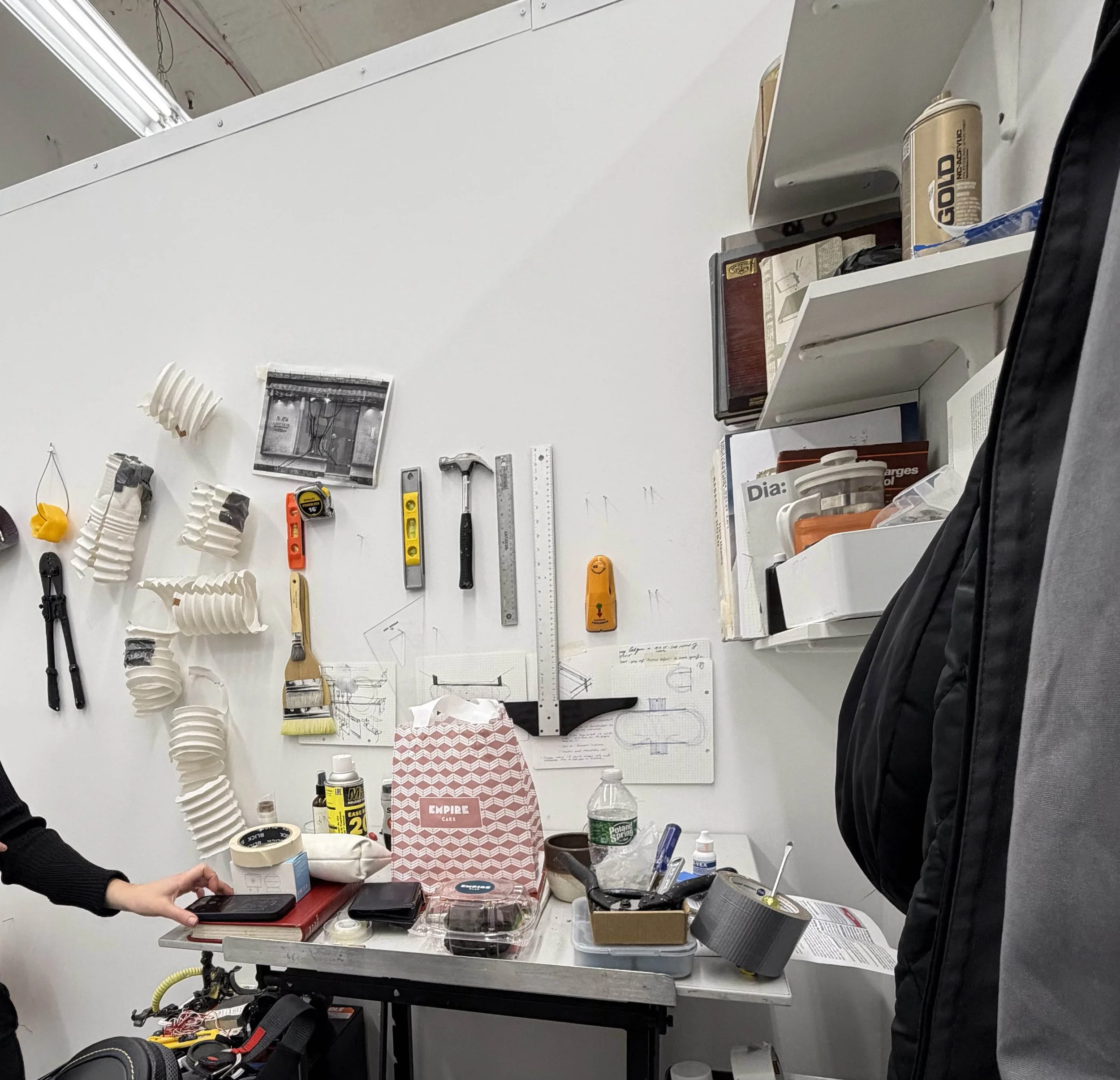
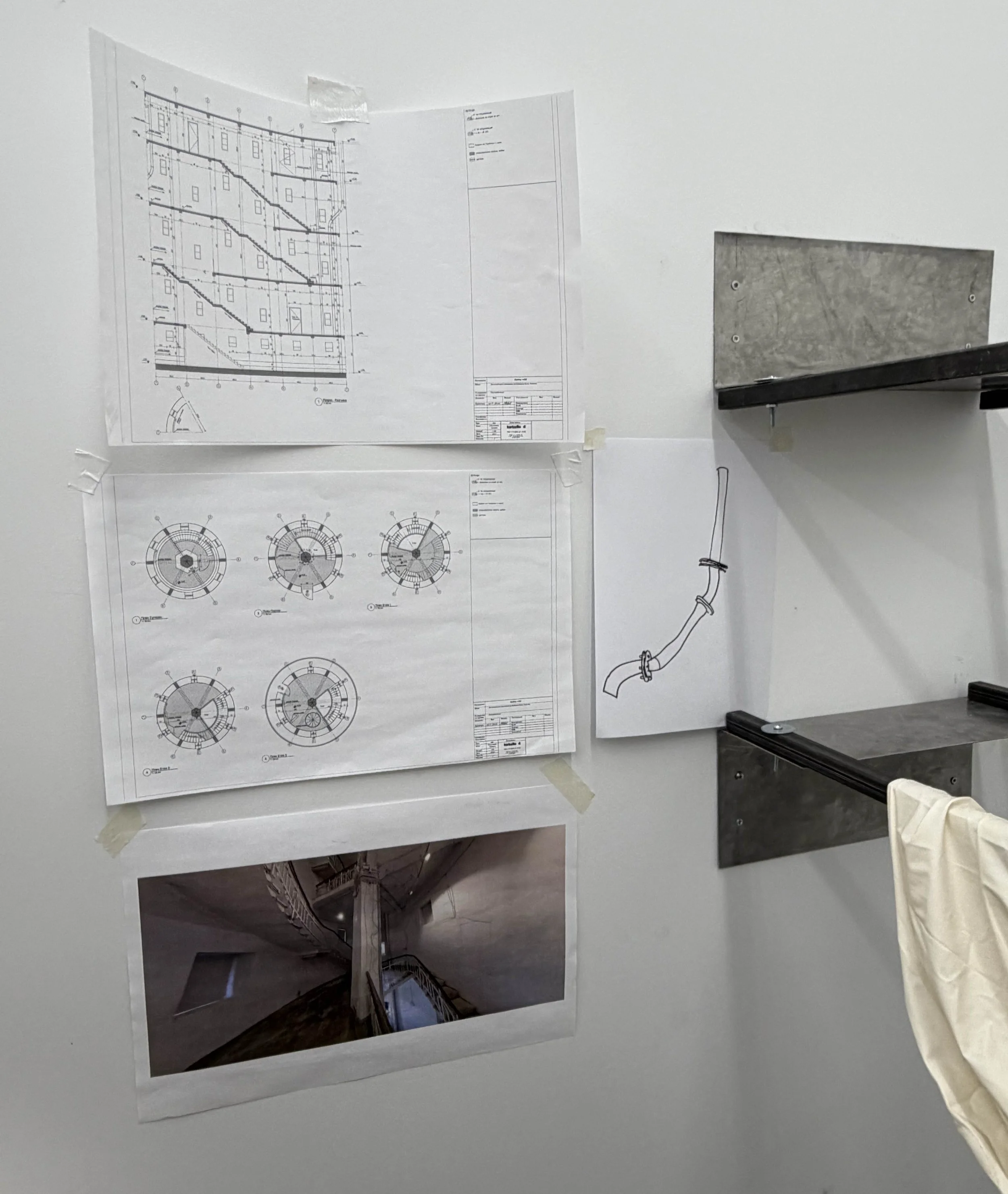
Her studio sits within the late-semester density of Parsons: urgency, fatigue, accumulation. But it does something more precise. It is not simply full. It is organized around a problem. Architectural drawings line the walls, slightly misaligned, plans, circular diagrams, fragments of systems. On the floor: debris, connectors, offcuts. Nothing finished, nothing casual.
Then the structure.
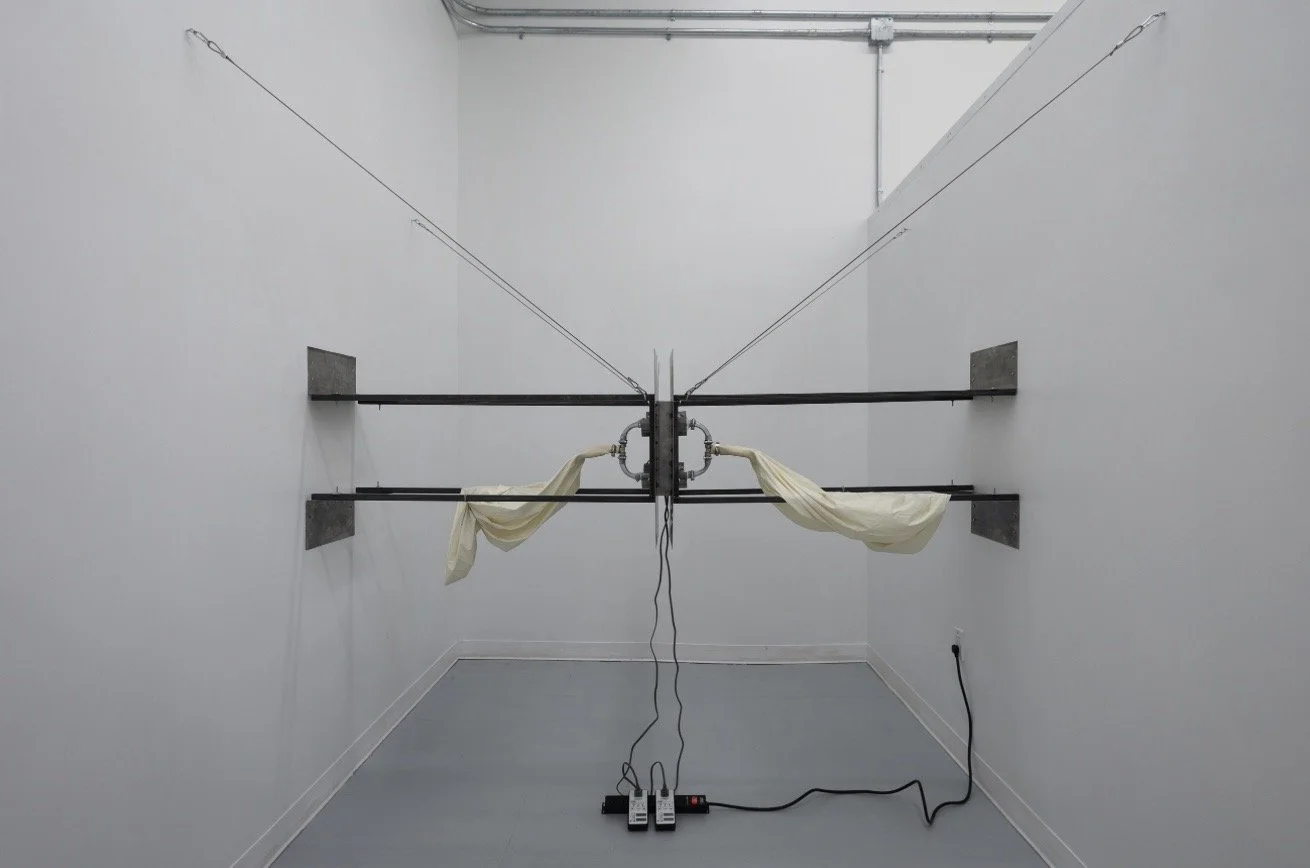
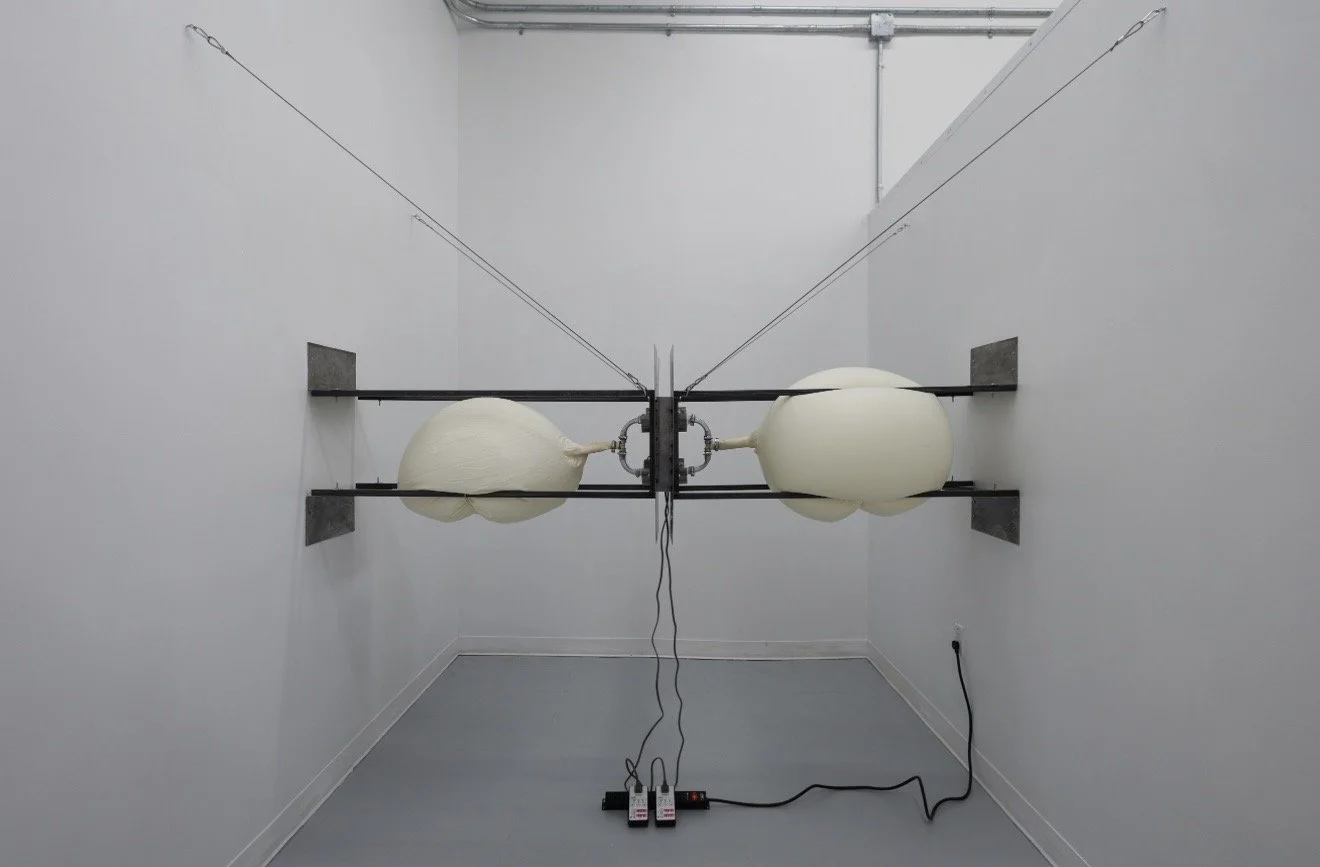
Steel beams span the narrow room under tension, anchored into the walls like provisional architecture. Cables stretch diagonally, stabilizing while exposing dependence. At the center, a mechanical core: pumps, valves, connectors, visibly assembled. Latex forms hang slack at first, like bodies before breath. The pumps hum without spectacle. Tape gathers at the joints. Connections are tightened, retightened, listened to. The system holds, but only through attention.
It is unclear what I am looking at. Not sculpture, not machine, not body, not architecture, but something held in place long enough to appear.
Courtesy of the artist, Veronika Desova
What the room presents is not an object but a relation maintained through operation. Veronika describes it as a “closed-loop,” an “exchange of air,” a condition of “interdependency.” “The exchange of air is the power itself,” she says. Shape is not prior to relation here. It is produced by it.
But the loop never closes. It depends on air it does not generate, on adjustments it cannot outgrow, on failures it cannot eliminate. The more insistently the work names interdependency, the more clearly it reveals that dependence exceeds the frame meant to organize it. What appears as relation is already structured.
Courtesy of the artist, Veronika Desova
Veronika had imagined “this infinite exchange,” something seamless, mechanical. Instead: “there’s always this tiny bit of air” escaping. Equilibrium becomes exhaustion. The system does not collapse. It diminishes. A perfect loop, she admits, would erase the human. Failure is not accident. It is the condition of legibility.
The piece occupies an unstable threshold, not between categories, but prior to their formation. It withholds the conditions under which a body could be recognized. There is no stable boundary, no continuity secured through function. Duration does not resolve. What remains is suspension, not as pause, but as time unable to complete itself.
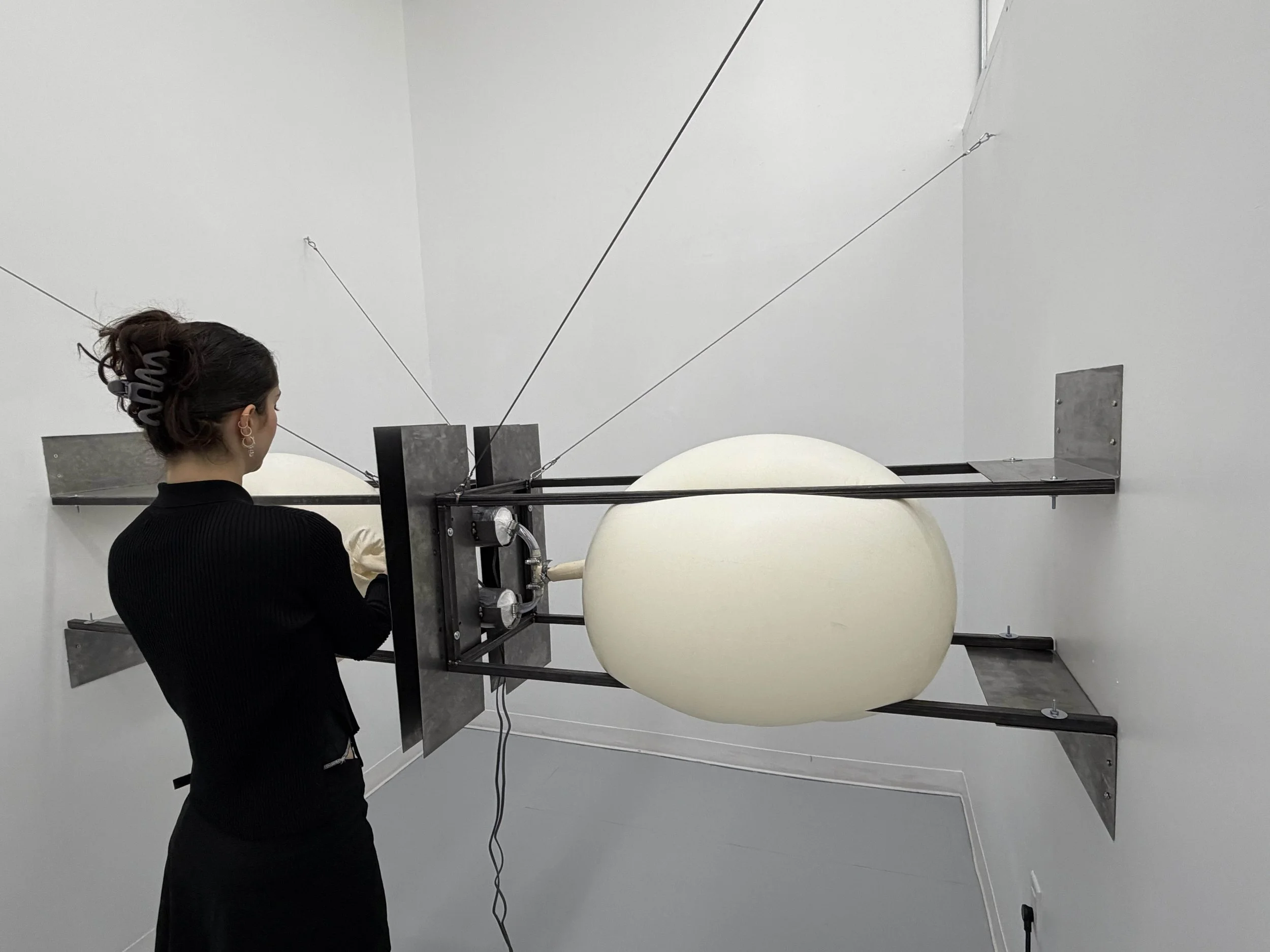
This instability is not a flaw. It is the intelligence of the work.
I am drawn to works that do not hide their scaffolding, not out of preference but necessity. Structure is most violent when it disappears into function, into the quiet authority of “this is simply how things work.” What matters here is not exposure alone, but what exposure permits: contingency, strain, dependence.
My investment in structure has never been formal. It has always been political. To speak of structure is to speak of distribution, dependency, asymmetry, not who connects, but who sustains whom, and at what cost.
What makes these forms bodily is not resemblance. There are no faces, no limbs, no skin, no gaze returned. And yet the body insists, through inflation, deflation, suffocation, dependency. The body appears not as image, but as condition.
Veronika traces this threshold precisely: “it isn’t a body… but you could imagine lungs… alveolus.” Elsewhere, a salvaged pipe becomes a “burst vessel,” tied to her mother’s aneurysm, to the reduction of life into pressure, fault, rupture. The body shifts inward, no longer contour but system.
The forms struggle. That struggle produces the body, not identity, but exposure.
But that response is not innocent. The work relies on a viewer already trained to read inflation as breath, deflation as suffocation. Empathy here is learned, not immediate. The body is reconstructed through inherited perception.
The title arrives first: Lovers. A word that preconditions the relation. Intimacy is assumed before it is encountered. Nothing in the structure supports it. There is no touch, no shared surface, no simultaneity. The two forms never meet. They are separated by a steel division that cuts through the work with unnecessary force. An “exaggerated slash,” Veronika says. It organizes the relation. It contains it. Each form exists within its own enclosure, what she calls an “independent cage,” yet neither can exist alone.
Separation becomes the condition of connection.
If there is intimacy, it is infrastructural. “They need a machine to be connected.” The bodies do not meet. They are mediated. What follows is not reciprocity, but alternation. One expands as the other diminishes. They are never full at the same time. Interdependency reveals itself as managed asymmetry, not intimacy but regulated exchange, not relation but a system of transfer in which giving is inseparable from depletion.
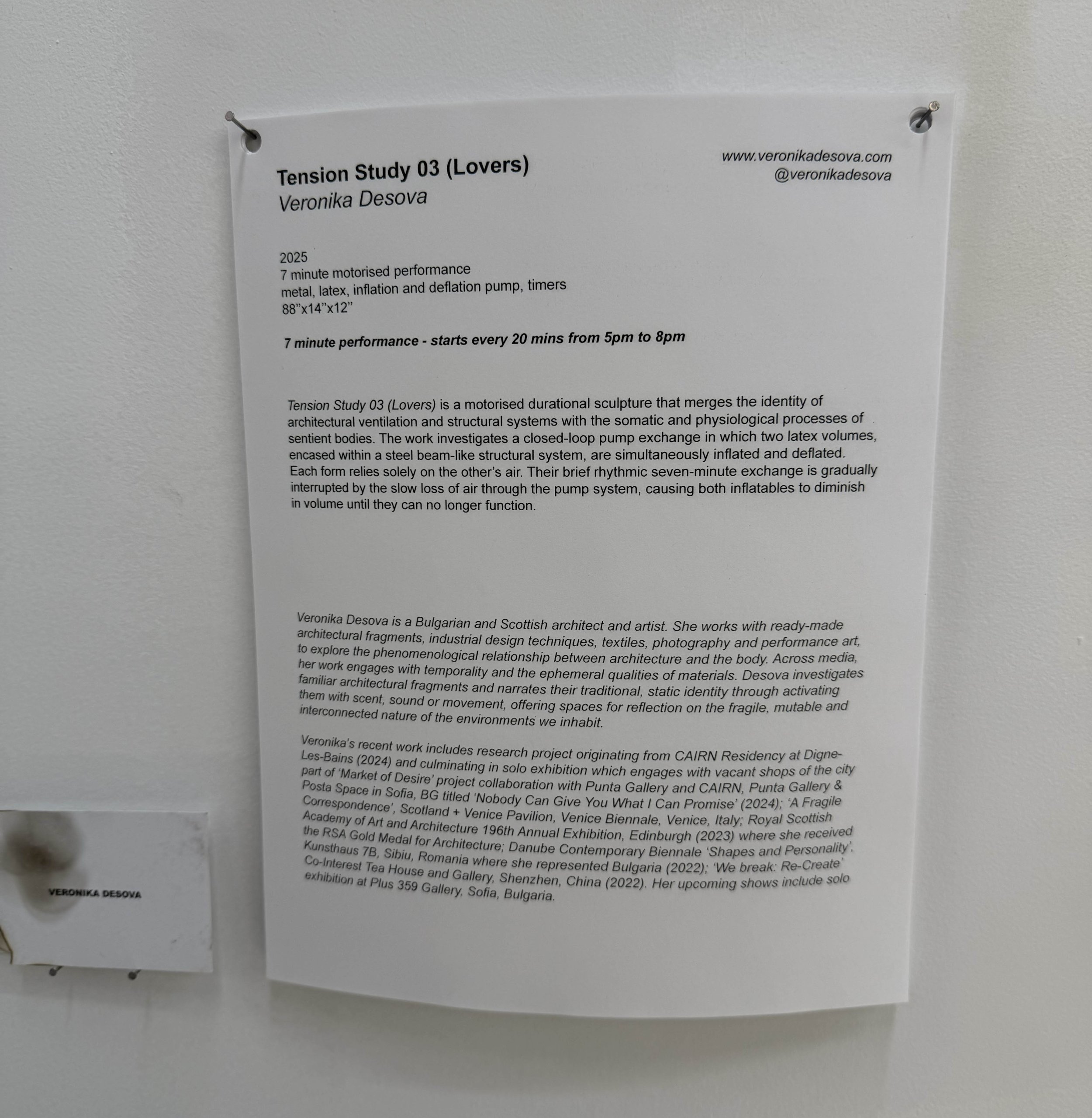
The title does not describe the work. It imposes a framework the structure refuses.
From here, the scale expands. Air, pressure, circulation. Buildings as organisms, as Veronika notes, systems regulating flows across space. What appears effortless is already structured. Air is not neutral. It is distributed, controlled, processed. The installation is not isolated. It is parasitic on a larger system.
The work becomes political at the moment it reveals this. Life is not simply lived. It is managed.
The work becomes most precise at its limit. The system cannot sustain itself. It leaks. It diminishes. It continues while collapsing. Failure is not event. It is condition.
Courtesy of the artist, Veronika Desova
A perfectly sealed loop would eliminate deviation. It would eliminate the human. But failure, repeated, risks stabilization. Exhaustion becomes form. Collapse becomes legible. The work holds this tension without resolving it.
We leave the first space, but not the system, and the transition refuses the comfort of separation.
The passage between rooms is not empty. It is populated by other practices, other attempts at making, other small systems trying to hold themselves together. On the way, a young man helps another student cut a piece of wood with a small, wireless chainsaw, a tool so light, so imprecise, that it feels closer to a toy than to an instrument of labor. It struggles against the material. It chatters more than it cuts. A simple hand saw would likely be more effective.
The scene lingers. Not because it is dramatic, but because something in it fails to meet resistance. The tool simulates force without fully engaging it. The gesture remains at a distance from what it claims to do.
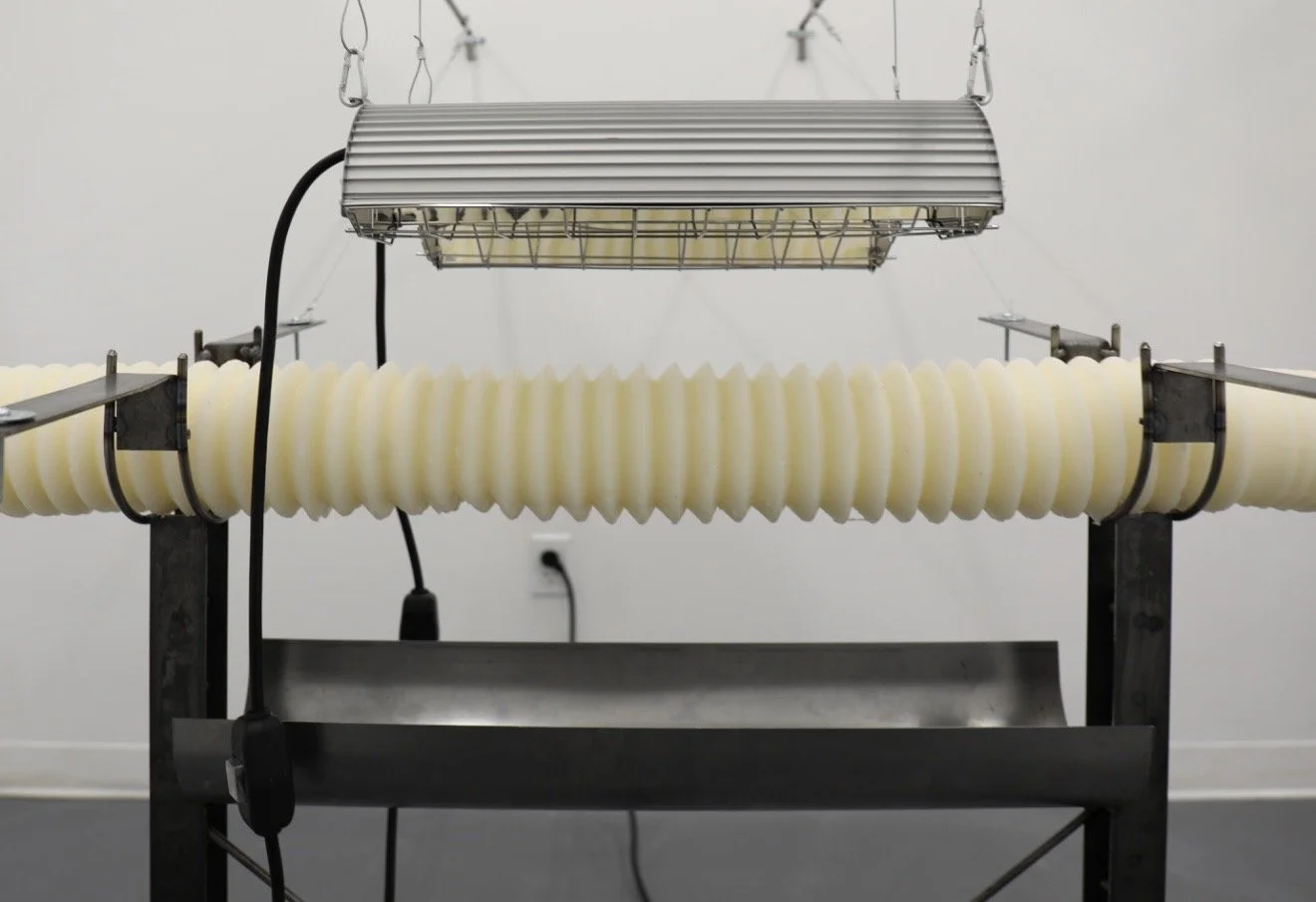
The transition is immediate, almost too clear. The air thickens. Wax softens before it visibly yields. The second work does not introduce a new problem. It inherits one and mutates it. Where the first piece struggles internally, this one is subjected externally. Pressure no longer moves through the system. It settles onto it.
Courtesy of the artist, Veronika Desova
A pipe cast in beeswax. Already failing.
Wax arrives preloaded with meaning. It does not resist. It confirms. Under heat, it softens, collapses. Failure is no longer encountered. It is guaranteed. The work is concerned with collapse, yet it selects a material that ensures its outcome.
Heat is applied. Care becomes exposure. Incubation becomes erosion. The metaphor arrives too easily. The viewer does not discover instability. They wait for it. What was contingency becomes sequence. The first work withholds structure. This one provides it. Failure unfolds predictably. Legibility replaces uncertainty.
The shift is subtle, but decisive. The second work stabilizes what the first destabilized. It converts epistemological uncertainty into readable process. Clarity increases. Pressure decreases. Material choice narrows the field.
Courtesy of the artist, Veronika Desova
Then the system shifts again.
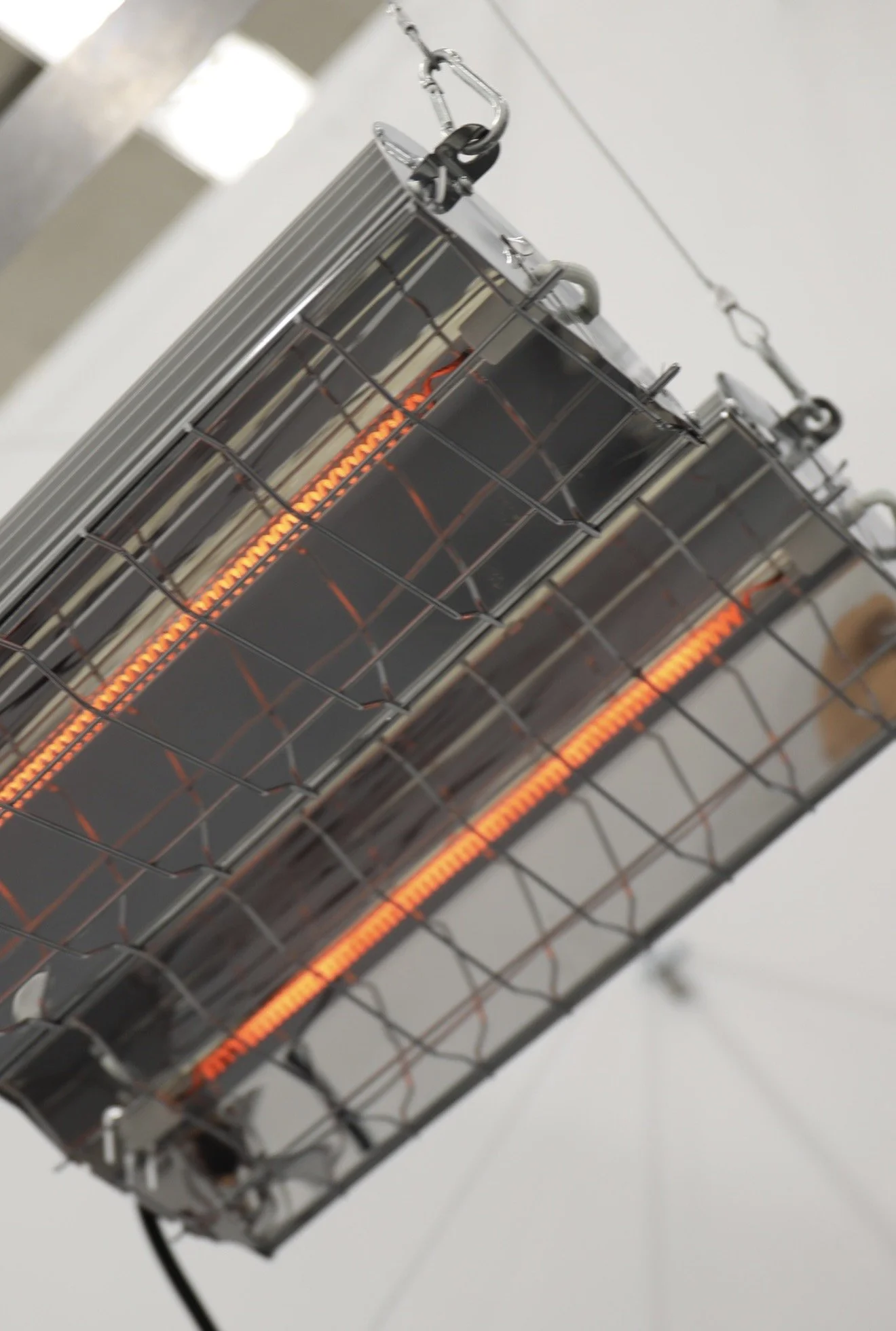
A PIR sensor activates the heaters when a body enters and stops when it leaves. The system waits, reacts, depends on presence. Collapse becomes intermittent. The viewer steps forward, the system responds. Steps back, it stops. A feedback loop.
The viewer learns the system, calibrates distance, adjusts behavior. Collapse becomes something to manage. The body is no longer observer. It becomes trigger, reduced to heat, to signal, to disturbance. No identity, no intention, only activation.
The system does not encounter a subject. It registers a threshold.
The viewer becomes infrastructure.
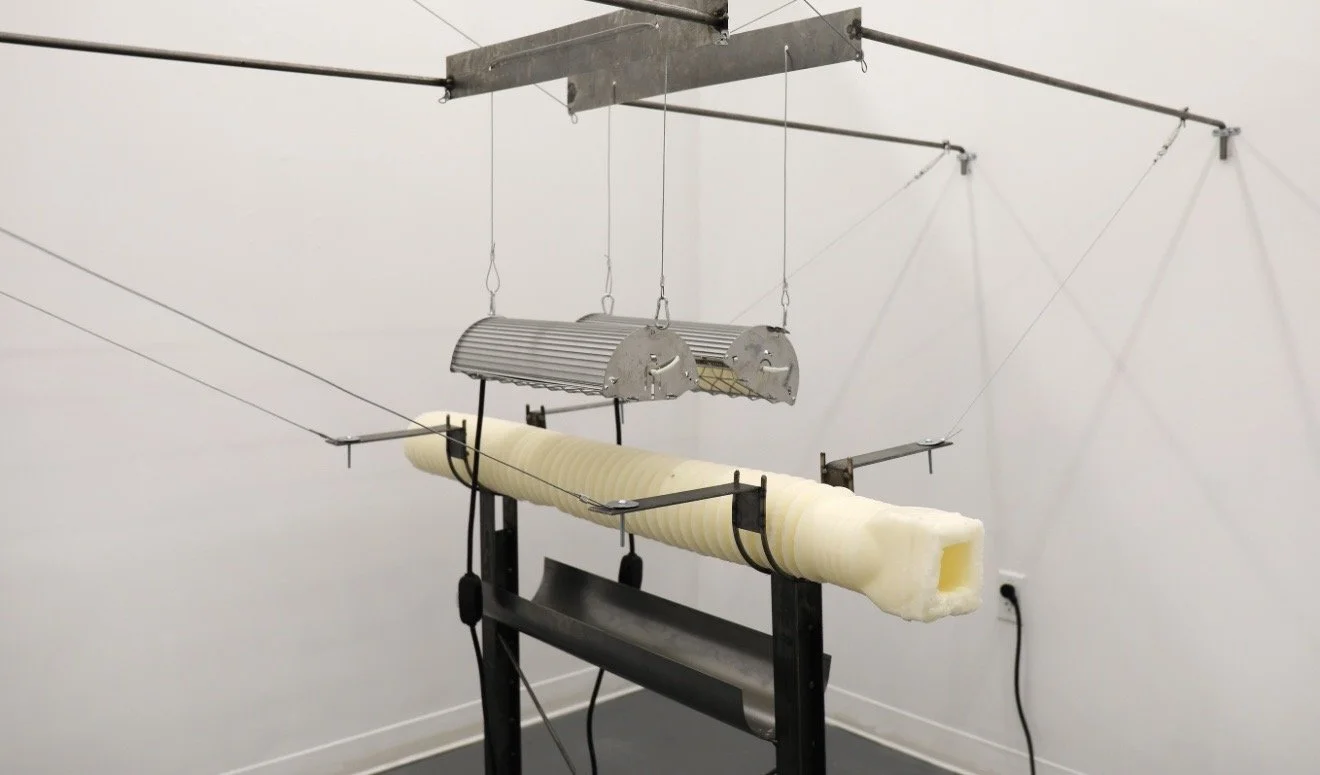
Courtesy of the artist, Veronika Desova
Wax translates detection into consequence. Heat into deformation. Cause and effect align too cleanly. The system does not invite interpretation. It confirms it.
At this point, the work risks something else: not just staging collapse, but training endurance. The viewer learns how to remain within visible breakdown without interrupting it. Collapse becomes observable, containable.
The political dimension emerges here, but it cannot remain abstract. Infrastructure, pressure, circulation are not metaphors. They reorganize what a body can endure. I know a version of collapse that does not wait for the viewer to approach. I know what it means for systems to stop being background, for air and access to become unstable conditions rather than guarantees.
What the work stages is exposure without consequence.
Courtesy of the artist, Veronika Desova
And yet it holds.
The pipe collapses. The wax spreads. The system continues. Failure is absorbed. What remains is not collapse, but its management.
The more unsettling possibility is that the work already knows this, that it does not produce understanding, but stages its limit. The viewer does not fail. They adapt.
What fails first is not the material, but the expectation that exposure produces transformation.
The system continues.
And so do we.
Not because it holds, but because it does not.